
AI Won't Replace User Research — Bad Research Might
AI-generated personas and synthetic users can feel like research. Accepted blindly, they create false confidence. Here's how to use AI as a research assistant, not a replacement for users.
There's a growing temptation in product teams: why spend weeks recruiting and interviewing users when you can ask an AI to "be" your user in seconds? Generate a few personas, run some synthetic interviews, collect the answers, move on.
It's fast. It's cheap. It sounds like research. And that's exactly the problem.
What synthetic users actually are
When you ask AI to respond as "a 34-year-old freelance designer who struggles with invoicing", it produces an answer based on patterns in its training data. It's a very good impression of what such a person might say, averaged across lots of text that exists about people like that.
It isn't that person. It has never missed a payment, chased a late client or lost an evening to spreadsheets. It can't surprise you with a problem nobody has written about yet — and those are often the problems worth solving.
The real risk: false confidence
The danger isn't that synthetic research is useless. It's that it looks convincing.
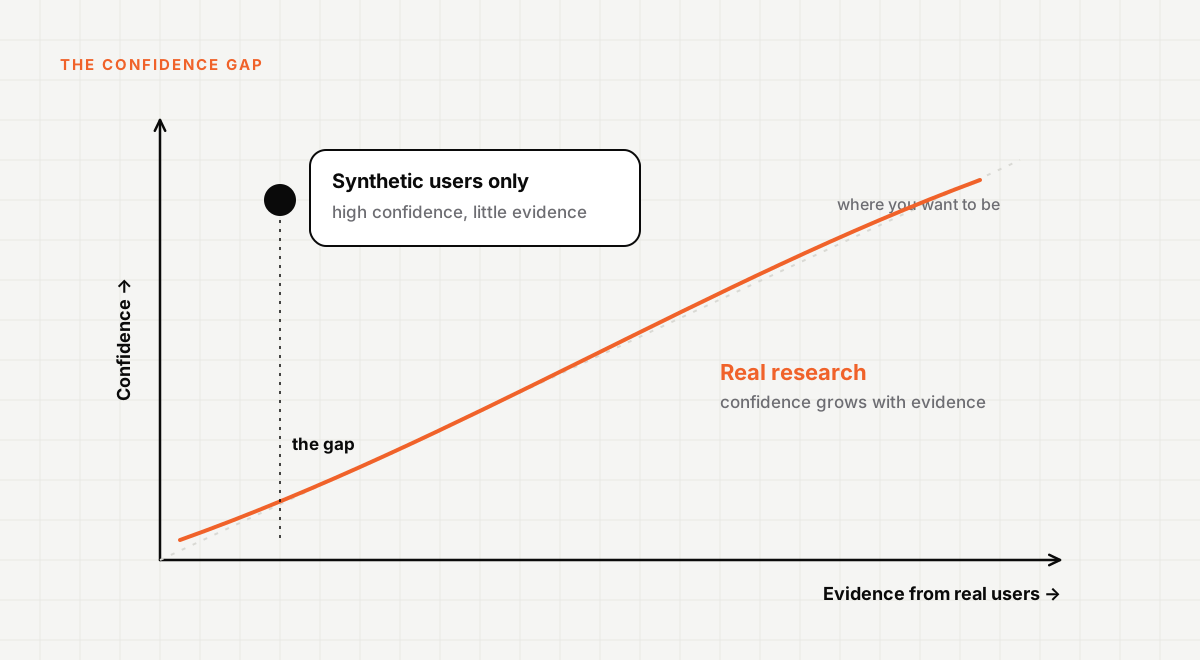
AI-generated personas come with names, backstories and neatly organised needs. Synthetic interview answers are articulate and on-topic. Real research is messy by comparison: people contradict themselves, go off on tangents, and struggle to explain what they want.
That messiness is where the insight lives. Removing it doesn't make research better. It makes it feel better, which is worse.
The most dangerous research finding is the one that confirms what you already believed and has no real person behind it.
How bad research happens
AI doesn't create bad research on its own. People do, when they:
- treat generated personas as facts instead of hypotheses
- skip real interviews because the synthetic ones "covered it"
- ask leading prompts and get the answers they wanted
- don't label AI output, so it quietly ends up in decks and roadmaps as "what users said"
- stop being surprised — if research never tells you anything unexpected, it probably isn't research
Notice that none of these are new problems. Leading questions, confirmation bias and made-up personas existed long before AI. AI just makes them faster and more polished.
Using AI as a research assistant
The healthy role for AI in research is assistant, not stand-in. Things it does well:
Before research
- turning assumptions into testable hypotheses
- drafting and reviewing interview guides
- suggesting perspectives and edge cases to recruit for
During analysis
- transcribing and summarising sessions
- clustering notes and feedback into themes
- finding quotes and moments to revisit
After research
- drafting summaries and reports — which a researcher then checks against the evidence
What it shouldn't do is provide the evidence itself.
When synthetic input is acceptable
There are reasonable uses. Stress-testing an interview guide. Exploring a problem space before recruiting. Generating edge cases for a usability test script. In each case, the output shapes how you do research — it doesn't replace the research.
The takeaway
AI is not going to replace user research. What it can do is make bad research look good enough to skip the real thing. The teams that avoid that trap are the ones who stay clear about the difference between what the model generated and what a real person actually did.
Talk to users. Use AI to talk to more of them, understand them faster and write it up better. Just don't let it talk for them.